
Stainless Steel Jewelry Production for Private Label
Private label is usually described as a branding arrangement. On the factory floor it is a sequence of eight operations, and the brand's requirements enter at every one of them. A stainless programme starts at 100+ pieces per design, with CAD under 48 hours, a 25–30 day sample and 3–4 weeks of bulk work. Knowing which steps belong to the factory and which belong to the buyer is what separates a smooth launch from a late one.

Key takeaways
- Eight factory steps run from concept drawing to global delivery, and six of them happen after the sample is approved.
- The stainless MOQ is 100+ pieces per design; three designs means at least 300 pieces.
- CAD is under 48 hours and the master sample 25–30 days, before 3–4 weeks of bulk production.
- Moulds, CAD files and the collection stay exclusive to the brand under a 100% NDA.
Eight steps, and who owns each one
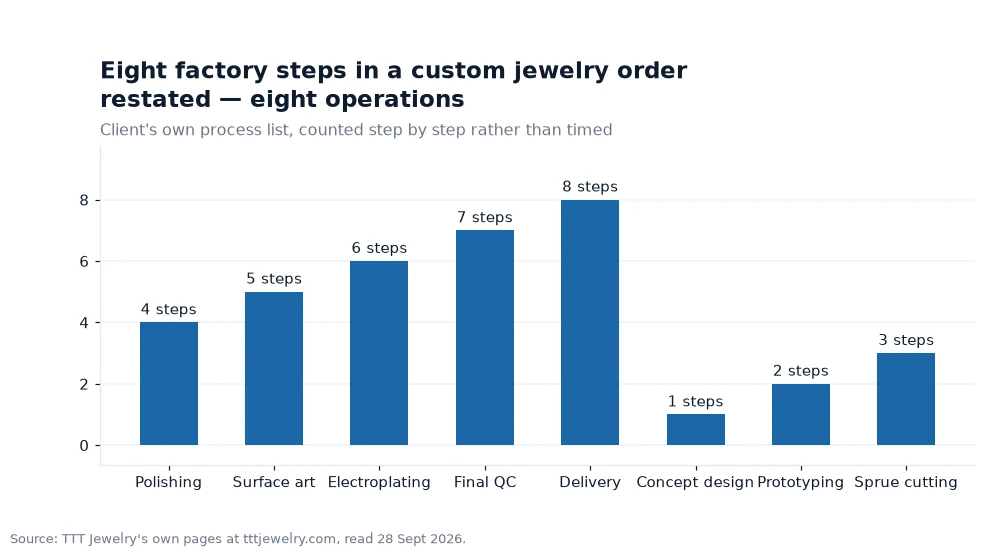
The published factory sequence is concept design, prototyping, sprue cutting, polishing, surface art, electroplating, final QC and delivery. A private-label buyer tends to think of the first step as theirs and the last as the factory's. In practice the split is less tidy: the buyer owns the brief and the approval, the factory owns the craft and the record, and each step needs a signature from one side before the next begins.
Concept design is hand-drawn and CAD. This is where the buyer's references, tech pack and any existing drawings enter the process. A sketch that shows a silhouette but not a wall thickness is not yet a concept in factory terms, because wall thickness determines whether the piece can be cast and polished without distortion.
Prototyping follows through a mould or 3D printing. The choice is a production decision rather than a stylistic one: a printed prototype is fast and useful for shape, while a mould-based prototype shows how the alloy behaves. For a private-label first run, seeing the alloy version before the sample stage reduces the chance of a second round.
Sprue cutting removes the channels through which metal entered the mould. It is unglamorous and it damages the piece if done carelessly: a cut too close to the surface leaves a gouge that polishing has to remove, thinning the wall in the process. A cut too far leaves a stub that shows after plating.
Polishing produces the high-gloss finish, and it is the step where a private-label piece either reads as premium or does not. Polishing rounds edges, softens detail and closes surface porosity. The amount of material removed is a quality variable, and it is why an approved sample has to be compared against production pieces rather than remembered.
Surface art adds brushed and textured finishes. This is where a collection gets visual variety from one set of castings: the same ring can ship in a mirror finish, a brushed finish or a textured one. Each variant is a separate routing decision, and a brand that offers three finishes has effectively tripled its finishing work even though the casting count has not changed.
Plating, inspection and the private-label moment
Electroplating is the published step for durable coating, with PVD vacuum plating used on stainless. The finish options are multi-layer 14K, 18K and 24K gold and rhodium, and the stainless route is where PVD does the work. A private-label programme that offers a gold tone and a steel tone is running two finishing routes, not one, and the sample should show both.
Final QC is 100% inspection, which means every piece is checked rather than sampled. For a private label this is the step that protects the brand name most directly, because the label is the only thing a customer can blame. A piece that fails here can still be reworked; a piece that ships cannot.
Delivery covers packing and global shipping, including the packaging elements published for custom orders: logo tags, foil-stamped boxes, pouches, backing cards and barcode labels. Private label commonly adds one more layer, the retailer's own label data, which has to be frozen before the cartons are sealed.
| Step | Operation | Brand approval | Typical window |
|---|---|---|---|
| 1 | Concept design, hand-drawn and CAD | Brief, references, dimensions | CAD under 48 hours |
| 2 | Prototyping by mould or 3D printing | Shape and wall thickness | Inside sampling |
| 3 | Sprue cutting and high-gloss polishing | Finish reference tile | Inside production |
| 4 | Surface art, brushed and textured | Variant list per SKU | Inside production |
| 5 | Electroplating or PVD coating | Colour and coverage standard | Inside production |
| 6 | Final QC and delivery | Acceptance criteria and pack data | Before shipping |
Why 316L suits a private label
316L is the stainless grade published for waterproof, shower-safe and swim-proof wear, helped by a 2–3% molybdenum content. It is also described as medical-grade hypoallergenic and as the grade that takes PVD most readily. For a private label sold on wearability, those are the claims that justify the material choice at the point of sale.
The material and finishing route is published by this 316L stainless steel jewelry manufacturer, and that page is the version to attach to a private-label brief before sampling starts.
The alternative is 304 stainless, published as water-resistant for daily wear, nickel and lead safe, and vacuum-plated for cost-effective volume. The distinction is not cosmetic. A brand promising swim-proof wear should specify 316L and test the claim; a brand selling fashion pieces for occasional wear can use 304 and price accordingly.
Both grades take laser engraving for a logo, and the published hallmark options include 316L alongside S925 and 18KGP. A private-label piece usually carries two marks, the brand and the alloy, and both should be approved on a coupon at the sample stage. The sterling silver jewelry manufacturer route handles the same marking question in silver, where the S925 stamp carries a different set of expectations.
What the NDA does and does not cover
Published terms include a 100% NDA, with designs, moulds and the collection kept exclusive and not resold or shown to other buyers. For a private label that is the core commercial protection: the shape a brand paid to develop cannot reappear under another label.
It does not cover the generic mechanics of production. A bezel setting, a cable chain or a PVD gold tone are industry techniques, not protected designs. A brand that wants differentiation has to put it into the drawing, the finish combination and the packaging, because those are the parts a competitor cannot copy from a photograph alone.
Ownership also shapes the reorder. When the mould and CAD belong to the buyer, a repeat run does not need a new concept or a new prototype, and the 25–30 day sample stage can be shortened to a finish check. That is the practical dividend of a first order done properly.
Worked example
A private-label launch with three designs at the stainless floor is 3 × 100 = 300 pieces. Across eight factory steps, that is 300 × 8 = 2,400 stage transitions, and the piece is only physically touched at the steps that require hands: sprue cutting, polishing, surface art, plating and inspection.
The calendar adds up in the same way. CAD is 48 hours, or 2 days. Sampling is 25–30 days, equal to 3.6–4.3 weeks. Bulk is 3–4 weeks, or 21–28 days. From CAD release to delivery: 2 + 25–30 + 21–28 = 48–60 days, about 7–9 weeks. A launch date inside eight weeks leaves no room for a second sample.
Now compare a two-finish programme. If one design ships in a mirror finish and a brushed finish, casting stays at 100 pieces but finishing doubles to 200 finishing passes for that design. Three designs with two finishes each become 600 finishing passes against 300 castings, which is the arithmetic behind a finishing surcharge that buyers sometimes mistake for a plating cost.
Frequently asked questions
What does private label mean in jewelry production?
The brand owns the design and the label, while the factory handles prototyping, production, finishing, inspection and packing to the buyer's specification.
How many pieces must a stainless design start with?
100+ pieces per design is the published minimum for stainless steel, against 100 for brass and 50 for sterling silver.
Who keeps the mould after the order ships?
The mould and CAD stay exclusive to the brand under a 100% NDA and are not resold or shown to other buyers.
Building the second order before the first ships
The first private-label run produces more than jewelry: it produces a reference sample, a finish standard, a packing spec and a record of which step caused any rework. Those four items are what make a reorder predictable, and they cost nothing to keep if the file is organized while the order is live.
Brands that extend into other metals can reuse most of that file. The custom brass jewelry line shares the eight-step structure and the packaging menu, so the difference sits in the alloy and the plating method rather than in the process.
Private label is not a shortcut past production. It is a clear division of labour: the brand defines the object and the standard, the factory executes the eight steps and documents them. The division only works when both sides know where the line sits.
Source note: figures come from the manufacturer's own website (tttjewelry.com), read 28 Sept 2026.[1]