
A subscription brand has an unusual sourcing problem: it picks a factory once and then lives with that choice for years, through every refill, price review and reformulation. That makes the selection sequence more valuable than any single comparison table, because most of the expensive mistakes are made before a sample is even requested. The seven steps below are ordered by how much they save when they are done early, and the two later sections explain where the sequence usually breaks. None of the steps are technical; they are all questions a buyer can ask in a first call.
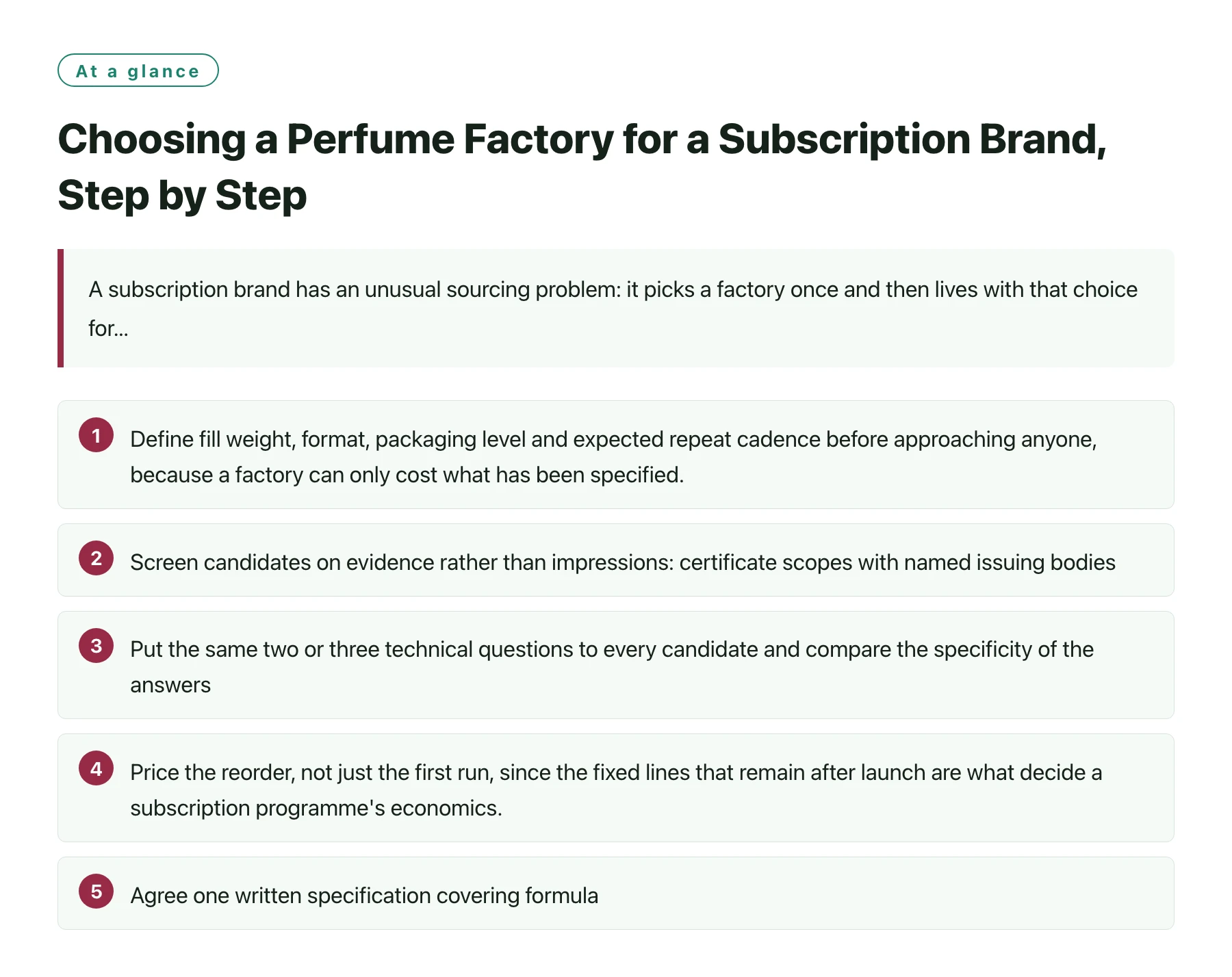
Key takeawaysDefine fill weight, format, packaging level and expected repeat cadence before approaching anyone, because a factory can only cost what has been specified. · Screen candidates on evidence rather than impressions: certificate scopes with named issuing bodies, a redacted batch record, and a sample document pack from an earlier project [1]. · Put the same two or three technical questions to every candidate and compare the specificity of the answers, which reveals more than any capability brochure [2]. · Price the reorder, not just the first run, since the fixed lines that remain after launch are what decide a subscription programme's economics. · Agree one written specification covering formula, dosage, fill tolerance, packaging, testing and reorder minimums before any tooling is ordered. · Finish with a paid trial order, because even a small one exposes the paperwork, the packing and the delivery chain before a customer calendar depends on them [3].
Buyers often start by collecting quotations, which feels efficient and is usually the slowest route. Until the purchase has been defined, every quote is answering a slightly different question, and comparing them produces a shortlist based on formatting rather than fit.
A subscription brand adds one more variable that a seasonal launch does not have: the relationship has to survive repetition. The factory's ability to reproduce the same fill, the same decorated bottle and the same paperwork two years from now is worth more than a lower first-order price, and it is much harder to assess from a price sheet.
The sequence that follows is written for a first-time buyer as much as for an experienced one. Each step produces a document or a decision, so by the end of the process the brand holds a specification, a scope statement and a tested supplier rather than a set of impressions.
Seven steps, in the order they save time
- Define what you are buyingWrite down the format, fill weight, packaging level, approximate annual volume and the repeat cadence you expect, because these four numbers determine which factories can even respond.
- Screen on evidence, not impressionsRequest certificate scopes with issuing bodies and expiry dates, a redacted batch record from a comparable product, and the documentation that normally travels with a shipment [1].
- Ask the same technical questions of every candidateChoose two or three questions on restricted materials, testing and reformulation, then compare how specific the answers are rather than how confident they sound [2].
- Cost the reorder, not only the first runAsk for pricing at three volumes and for a statement of which lines are fixed, which are variable, and what would trigger a price change.
- See the operation, in person or on a live callCompounding, filling and packing are the areas worth seeing; a recorded walkthrough is an acceptable substitute if travel is not practical.
- Agree one specification documentFormula, dosage, fill tolerance, packaging specification, test list and reorder minimum belong in a single signed document with a version number.
- Run a paid trial orderA small paid run exercises the whole chain, including invoicing, packing lists and delivery, at a cost that is trivial next to a failed launch.
Steps two, four and six are the ones buyers skip when a supplier is charming, and they are the three that protect a subscription programme most. Certificates and a batch record are verifiable; a price structure is comparable; a signed specification is enforceable [3]. The sequence itself is a working method rather than a checklist, and the same reasoning runs through Xuelei's guide to factory selection.
Where the sequence earns its keep
The order matters because each step narrows the field for the next one. A brand that screens before it specifies will collect glossy capability documents that say nothing about its own product, and a brand that specifies before it screens will send a detailed brief to factories that cannot make the format at all.
It is also how a two-month evaluation stays a two-month evaluation. Without a sequence, an evaluation drifts: samples arrive, opinions accumulate, and nobody can say which candidate failed which test.
The two questions that separate candidates fastest
Ask what happens when a fragrance material in the approved formula becomes restricted, and ask which tests will be run on the finished pack and by whom. A factory that answers with a process, a name and a timeline is describing how it works. One that answers with reassurance is describing how it sells.
The same principle applies to ownership and rights, which is why due diligence on a perfume manufacturer should include a plain question about who owns the formula and what the brand may do with it if the relationship ends. Buyers who leave that question for the contract stage often discover that the answer is more restrictive than they assumed.
Why a trial order is not optional
A paid trial is the only step that tests the parts of a factory nobody markets: how a purchase order is confirmed, how a discrepancy is raised, how long a reply takes, and whether the delivered carton matches the specification. Those are the behaviours a subscription brand relies on every month, and they cannot be assessed from a sample box or a factory tour.
If time is short, compress the steps in this order instead of dropping them: shorten the screening list to three candidates, run the technical questions and the volume pricing by email in the same week, and book the walkthrough and the trial order in parallel. What should never be compressed is the written specification, because that single document is what makes a reorder a formality and a dispute a conversation rather than a delay. Comparing a a Chinese factory for perfume brands against a local one on these terms is usually more informative than comparing headline prices.
Sources
- SGS: Cosmetics, Personal Care & Household Testing —— Testing, inspection and certification services for cosmetics and personal care, including microbiological, stability and safety testing aligned with cosmetics GMP.
- IFRA Standards Library (International Fragrance Association) —— The IFRA Standards Library lists the restrictions the fragrance industry applies to individual fragrance ingredients, based on safety assessments; it is the reference point for compliant fragrance formulation.
- Cosmetics Europe —— The European trade association for the cosmetics and personal care industry, publishing guidance, positions and market information.
Frequently asked questions
How long should choosing a perfume factory take?
A focused evaluation usually runs four to eight weeks if the brief is ready at the start, with screening and technical questions taking the first two and sampling or a trial order taking the rest. Most delays come from an undefined brief rather than from slow factories.
Should I visit the factory before deciding?
If budgets allow, a visit shows scale, housekeeping and how compounding and filling are separated, which no document conveys. When travel is not practical, a live video walkthrough with questions allowed during the call is a reasonable substitute, and it should be treated as evidence rather than as a courtesy.
What does a paid trial order actually prove?
It proves the commercial chain works end to end: order confirmation, production scheduling, packing, documentation and delivery. It also gives the brand a genuine reference for fill, spray and finish before it commits to a recurring volume.
How many factories should a subscription brand evaluate?
Three is usually enough to compare without becoming a project of its own. Fewer than three makes it hard to judge whether an answer is normal practice or a quirk; many more than three adds administration without changing the decision.
What is the single most useful document to hold after selection?
A signed specification with a version number. It fixes the formula, dosage, fill tolerance, packaging and test list in one place, so a reorder, a reformulation or a dispute can all be handled by referring to something both sides already agreed.