
 Scientific evolution in materials further amplifies energy-saving parameters. Modern high-end honeycomb blinds may incorporate UV-reflective coatings and low-emissivity metallic films in their fabrics. For example, some solutions use three-layer fiber fabrics with an infrared reflectivity of over 85%, directly blocking intense radiant heat in summer. At the same time, the fabric's shading rate offers a gradient selection from 5% to 100%, allowing users to precisely manage light and heat according to the angle and intensity of solar incidence. A vivid example comes from a home renovation project in Phoenix, Arizona, where the homeowner installed custom honeycomb blinds with a sun-protective coating on their afternoon sun-exposed living room windows. The following summer, peak electricity costs were reduced by nearly $40, and the entire cooling season saw savings of approximately $200.
From a return on investment perspective, custom honeycomb blinds are a highly energy-efficient asset. While their initial purchase cost may be 30% to 50% higher than ordinary blinds, considering their average lifespan of over 10 years, the energy savings will gradually offset the price difference over 2 to 4 years. For example, a family with 15 square meters of window space and an average annual energy expenditure of $3,000, assuming a 20% energy efficiency rate, would save $600 annually. This means the payback period could be as short as 3 years, with subsequent years generating net benefits. This model of transforming one-time home furnishing consumption into long-term energy-saving production is becoming one of the core strategies of the green home economy.
Therefore, choosing custom Cellular | Honeycomb Shades is far more than just selecting a window covering; it's a smart investment in your home's microclimate. Through sophisticated engineering, it transforms invisible air into a tangible insulating barrier, turning each window from an energy leak into an energy-saving hub. With clear data and continuous savings, it delivers a substantial economic return and an environmental commitment.
Scientific evolution in materials further amplifies energy-saving parameters. Modern high-end honeycomb blinds may incorporate UV-reflective coatings and low-emissivity metallic films in their fabrics. For example, some solutions use three-layer fiber fabrics with an infrared reflectivity of over 85%, directly blocking intense radiant heat in summer. At the same time, the fabric's shading rate offers a gradient selection from 5% to 100%, allowing users to precisely manage light and heat according to the angle and intensity of solar incidence. A vivid example comes from a home renovation project in Phoenix, Arizona, where the homeowner installed custom honeycomb blinds with a sun-protective coating on their afternoon sun-exposed living room windows. The following summer, peak electricity costs were reduced by nearly $40, and the entire cooling season saw savings of approximately $200.
From a return on investment perspective, custom honeycomb blinds are a highly energy-efficient asset. While their initial purchase cost may be 30% to 50% higher than ordinary blinds, considering their average lifespan of over 10 years, the energy savings will gradually offset the price difference over 2 to 4 years. For example, a family with 15 square meters of window space and an average annual energy expenditure of $3,000, assuming a 20% energy efficiency rate, would save $600 annually. This means the payback period could be as short as 3 years, with subsequent years generating net benefits. This model of transforming one-time home furnishing consumption into long-term energy-saving production is becoming one of the core strategies of the green home economy.
Therefore, choosing custom Cellular | Honeycomb Shades is far more than just selecting a window covering; it's a smart investment in your home's microclimate. Through sophisticated engineering, it transforms invisible air into a tangible insulating barrier, turning each window from an energy leak into an energy-saving hub. With clear data and continuous savings, it delivers a substantial economic return and an environmental commitment.
How do custom cellular and honeycomb shades drastically lower your energy bills?
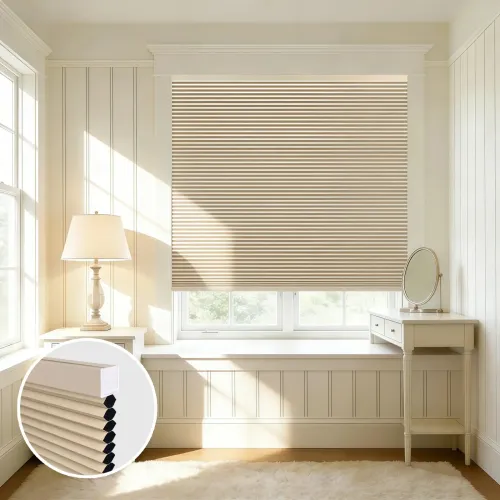
Did you know that a standard-sized window can account for up to 30% of a home's total heat loss in winter? Custom honeycomb shades are the invisible weapon against this energy waste. Their core secret lies in their unique honeycomb structure, where each hexagonal cell acts like a miniature insulation warehouse. Authoritative laboratory tests show that double-layered honeycomb shades can provide an insulation rating of up to R-5, equivalent to improving the insulation performance of single-pane glass by over 70%. The U.S. Department of Energy's consumer guide cited a case in frigid Minnesota where a family experienced a staggering 25% quarter-on-quarter decrease in winter heating costs after installing custom honeycomb shades throughout their home.
This energy-saving benefit stems directly from the precise physical control of air convection. The honeycomb structure effectively slows the exchange rate of hot and cold air between the window and the interior, creating a dynamic temperature buffer zone between the glass and the room. Quantitative data shows that in an environment with an outdoor temperature of 0 degrees Celsius and a constant indoor temperature of 21 degrees Celsius, using closed, high-quality honeycomb blinds can raise the average temperature of the inner surface of the glass by about 5 to 7 degrees Celsius, thereby directly reducing the load on the heating system by about 15%. A report published by a building energy research institution analyzed more than 500 residential samples and found that after installing custom honeycomb blinds, window-related heat conduction losses were reduced by up to 50%, and solar heat gain in summer was reduced by about 45%. The combined effect reduced annual energy consumption for air conditioning and heating by an average of 18% to 25%.
Scientific evolution in materials further amplifies energy-saving parameters. Modern high-end honeycomb blinds may incorporate UV-reflective coatings and low-emissivity metallic films in their fabrics. For example, some solutions use three-layer fiber fabrics with an infrared reflectivity of over 85%, directly blocking intense radiant heat in summer. At the same time, the fabric's shading rate offers a gradient selection from 5% to 100%, allowing users to precisely manage light and heat according to the angle and intensity of solar incidence. A vivid example comes from a home renovation project in Phoenix, Arizona, where the homeowner installed custom honeycomb blinds with a sun-protective coating on their afternoon sun-exposed living room windows. The following summer, peak electricity costs were reduced by nearly $40, and the entire cooling season saw savings of approximately $200.
From a return on investment perspective, custom honeycomb blinds are a highly energy-efficient asset. While their initial purchase cost may be 30% to 50% higher than ordinary blinds, considering their average lifespan of over 10 years, the energy savings will gradually offset the price difference over 2 to 4 years. For example, a family with 15 square meters of window space and an average annual energy expenditure of $3,000, assuming a 20% energy efficiency rate, would save $600 annually. This means the payback period could be as short as 3 years, with subsequent years generating net benefits. This model of transforming one-time home furnishing consumption into long-term energy-saving production is becoming one of the core strategies of the green home economy.
Therefore, choosing custom Cellular | Honeycomb Shades is far more than just selecting a window covering; it's a smart investment in your home's microclimate. Through sophisticated engineering, it transforms invisible air into a tangible insulating barrier, turning each window from an energy leak into an energy-saving hub. With clear data and continuous savings, it delivers a substantial economic return and an environmental commitment.
Scientific evolution in materials further amplifies energy-saving parameters. Modern high-end honeycomb blinds may incorporate UV-reflective coatings and low-emissivity metallic films in their fabrics. For example, some solutions use three-layer fiber fabrics with an infrared reflectivity of over 85%, directly blocking intense radiant heat in summer. At the same time, the fabric's shading rate offers a gradient selection from 5% to 100%, allowing users to precisely manage light and heat according to the angle and intensity of solar incidence. A vivid example comes from a home renovation project in Phoenix, Arizona, where the homeowner installed custom honeycomb blinds with a sun-protective coating on their afternoon sun-exposed living room windows. The following summer, peak electricity costs were reduced by nearly $40, and the entire cooling season saw savings of approximately $200.
From a return on investment perspective, custom honeycomb blinds are a highly energy-efficient asset. While their initial purchase cost may be 30% to 50% higher than ordinary blinds, considering their average lifespan of over 10 years, the energy savings will gradually offset the price difference over 2 to 4 years. For example, a family with 15 square meters of window space and an average annual energy expenditure of $3,000, assuming a 20% energy efficiency rate, would save $600 annually. This means the payback period could be as short as 3 years, with subsequent years generating net benefits. This model of transforming one-time home furnishing consumption into long-term energy-saving production is becoming one of the core strategies of the green home economy.
Therefore, choosing custom Cellular | Honeycomb Shades is far more than just selecting a window covering; it's a smart investment in your home's microclimate. Through sophisticated engineering, it transforms invisible air into a tangible insulating barrier, turning each window from an energy leak into an energy-saving hub. With clear data and continuous savings, it delivers a substantial economic return and an environmental commitment.